Ultimate Guide To AI Search Optimization (and how to show up in AI Overviews)
Getting your brand mentioned more by AI
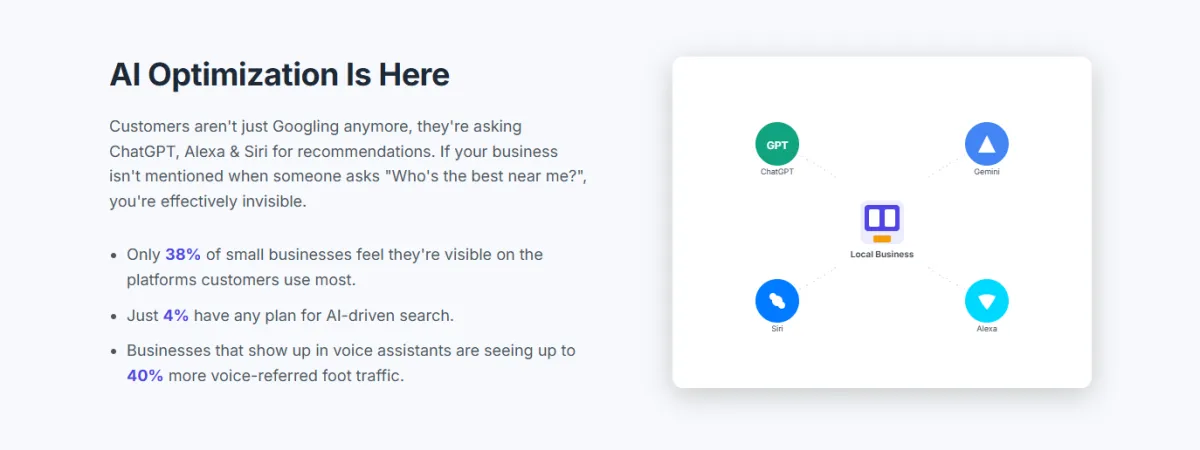
In 2025, more people than ever are turning to AI chatbots and generative search for answers. Whether it’s ChatGPT, Bing Chat, or Google’s new AI Overviews, these AI tools are increasingly suggesting businesses, software, and services in their answers.
For business owners – from SaaS founders to local business owners – this shift means a new kind of visibility to strive for. You don’t just want to rank on a webpage anymore; you want AI to mention your business when users ask for recommendations.
In this guide, we’ll explore how you can increase your chances of being mentioned or recommended in AI-generated answers across platforms.
Why AI Visibility Matters in 2025...
AI-driven search isn’t a future trend – it’s here now. Roughly 27% of Americans have already started using AI chatbots instead of Google for certain searches, and 60% of U.S. consumers used an AI chatbot to research or decide on a product in the last month.
ChatGPT alone attracts hundreds of millions of visits per month, and over two-thirds of consumers say they’re likely to use ChatGPT over a traditional search engine to find information. Gartner even predicts that by end of 2026, traditional search volume could drop 25% as users shift to AI assistants.
For businesses, this means a chunk of your potential customers are asking AI for “the best project management tool” or “a good plumber near me” and making purchasing decisions based on those answers.
AI visibility matters because it’s becoming a new competitive battleground. Just as businesses spent the last two decades optimizing for Google, now we have to consider optimization for AI-driven platforms.
The good news is that many of the same fundamentals of SEO and online marketing still apply – with some new twists.
Dominate AI Search In Your Local Area.
We GUARANTEE To Get You AI Search Traffic Within 30 Days.
$50/Month - Results Guaranteed
Click Here
How AI Tools Retrieve and Recommend Information
Before diving into tactics, it helps to understand how AI like ChatGPT, Bing Chat, or Google SGE finds information and decides what to mention.
Unlike a traditional search engine that shows a list of links, these AI systems generate answers by pulling from multiple sources:
AI Chatbots (ChatGPT, etc.) with Web Access:
Modern AI chatbots use a technique called retrieval augmented generation, meaning they fetch current content from the web and then synthesize an answer.For example, ChatGPT has a partnership with Bing – when you ask it a question beyond its built-in knowledge, it will search Bing’s index for relevant pages.
In effect, ChatGPT is looking at search engine results (often Bing’s results) and using those webpages to form its answer. If a user asks “What’s the best call tracking software?”, ChatGPT/Bing will scour the web for articles or lists of call tracking tools, then compile an answer like CallScaler.
If your business is mentioned on those top web pages, it has a chance of being included in the AI’s response.
Bing Chat (Microsoft Copilot): Bing Chat works hand-in-hand with the Bing search engine. It actually performs a web search and then presents an answer with citations. Bing Chat heavily relies on the top organic search results, often quoting or citing the exact pages that rank well on Bing. It may also pull from knowledge panels or structured data for facts.
This means if your website or a mention of your business isn’t in Bing’s first page results for a relevant query, Bing Chat is unlikely to mention you. On the flip side, a strong presence in Bing results almost guarantees Bing’s AI will pick it up.
Google’s AI Overviews:
Google AI Overviews is Google’s AI-powered search result, which generates a summary answer at the top of search queries. SGE draws from Google’s index of websites (the same pool as regular search results) and often cites 2-3 sources for each piece of info. Notably, SGE tends to use content from sites that already rank well or directly address the query.
For example, for an exploratory query like “Which CRM software is best for small business?”, SGE might take info from a “Top 10 CRMs” article and a comparison blog, merging points from each. In fact, many SGE answers lean on “Top X” list posts, “Best [category]” articles, and detailed how-to or comparison guides. Google’s AI is essentially remixing the content that SEO already put on page one.
Roundup and Review Sites:
Across both Bing Chat and SGE (and even other AI like Bard or Perplexity), a common pattern has emerged: when users ask for the “best” of something, the AI often pulls from roundup posts, rankings, and review sites.
If multiple top-ranking articles all mention a certain business as a recommended option, the AI sees that consensus and is more likely to include that business in its synthesized answer. In other words, if five different “Best X Tools” posts all list CallScaler as a top call tracking software, an AI answer will probably mention CallScaler as well because those sources feed it that information.
In summary, AI answers are built on existing online content. To get your business into those answers, you need to ensure that the information AI systems consume (search results, articles, data sources) includes your brand.
Let’s break down the strategies to achieve that.
Dominate AI Search In Your Local Area.
We GUARANTEE To Get You AI Search Traffic Within 30 Days.
$50/Month - Results Guaranteed
Click Here
SEO Strategies to Boost Visibility in AI Answers
Many of the tactics for appearing in AI responses start with classic SEO – because better search presence means better AI presence. According to experts, if you’re ranking higher in search results, you’ll show up more in AI responses.
Here’s how to tailor your SEO for the AI era:
1. Nail the Basics: Be on Page One
(Especially on Bing and Google). The first step is still to rank well for relevant queries. AI platforms tend to pull from the first page of results. Focus on solid on-page SEO and content optimization for the keywords and questions your target audience is asking.
This includes:
Keyword Research for Questions:
Identify natural-language queries your customers might ask (e.g., “how to reduce customer churn SaaS” or “best coffee shop in [city]”). Tools like AnswerThePublic or Semrush’s question keywords can help. Optimize content around those queries, using the question in a header and answering it clearly in the text.
High-Quality, Relevant Content:
Create in-depth content that directly addresses the topic. AI models favor comprehensive, well-structured answers just as Google does. Write authoritative blog posts, guides, and FAQs that cover the who/what/why/how of your industry questions. Thin or fluffy content won’t earn top rankings or AI mentions – in fact, Google’s SGE is reported to “ignore SEO fluff” and focus on substantive info.
On-Page Structure & Clarity:
Use clear headings, subheadings, and bullet points to make your content easy to digest (for both humans and AI). Structured content with distinct sections and factual statements is easier for AI summarizers to ingest and attribute. For instance, consider adding an “Executive Summary” or key takeaways at the top of long articles.
Early tests show SGE often pulls from summary sections and straightforward HTML text, skipping over content hidden behind tabs or heavy scripts. Make sure your crucial points are visible in the raw HTML (i.e., not requiring a click or JavaScript to display).
Page Speed and Technical SEO:
Ensure your site loads fast and is mobile-friendly. Not only do traditional rankings benefit from this, but AI search tends to favor sites that load quickly. Google’s SGE, for example, more eagerly cites content from “lightweight” websites that don’t require complex scripts to read. A well-optimized, accessible site (fast server, clean code, proper meta tags) increases the chance that AI will be able to crawl and extract your content.
2. Optimize for Bing as well as Google.
Don’t neglect Bing SEO, since Bing powers not just its own search but also ChatGPT’s browsing. Submit your sitemap to Bing Webmaster Tools and follow Bing’s SEO guidelines. In many cases, strong Google SEO will translate to good Bing rankings, but there are a few nuances:
Bing may place relatively more weight on social signals and exact match keywords. While you shouldn’t stuff keywords (that backfires on AI understanding), do make sure your page titles and headings clearly include the product/service you offer.
Claim and optimize your Bing Places listing if you are a local business. Just as Google Business Profiles help with visibility in maps and local packs, a Bing Places profile can feed information to Bing Chat when someone asks, for example, “Find a bike shop near me on Bing Chat.”
Keep an eye on your Bing search rankings for key queries. If you’re doing well on Google but not on Bing, investigate why (Bing’s webmaster tools can flag issues). Sometimes small tweaks—like different meta description wording or ensuring no crawl errors—can boost Bing performance.
3. Provide Direct Answers and Use Schema Markup.
AI answers love when content explicitly answers the question. Wherever relevant, incorporate FAQ sections or Q&A format content on your site, answering common questions in your niche.
For example, a local HVAC company could have Q&As like “Q: How often should I service my air conditioner? A: …”. These concise answer formats might be pulled verbatim by an AI. Implementing structured data (schema.org markup) for FAQs, products, reviews, etc., can also help search engines understand and feature your content.
While current AI summaries rely mostly on plain HTML text (one study found SGE only used schema markup <1% of the time), schema does feed the knowledge graph and snippets that could indirectly influence AI results. At minimum, schema won’t hurt – and it might ensure your business details (hours, prices, star-ratings) are accurately known to AI.
4. Focus on Authority and Earn Mentions (Off-Page SEO). Traditional off-page SEO – especially backlinks and brand mentions – plays into AI visibility. Why? Because if many reputable sites talk about your brand or link to your content, that content is more likely to rank highly and be viewed as a trusted source by AI algorithms.
Aim to:
Build quality backlinks from industry sites, blogs, or news outlets. A SaaS founder might guest post on a respected tech blog, earning a link and a mention of their product. An AI scanning the web sees those citations and “votes of confidence.”
Encourage press coverage or case studies featuring your business. For example, if you run a marketing agency, getting mentioned in a Forbes article about top agencies will increase the likelihood that AI finds your agency notable when compiling answers about marketing services.
Keep information consistent across the web.
Ensure your company name, descriptions, and facts (like location, pricing, etc.) are consistent on your website and all external listings. AI tools pull data from diverse sources and rely heavily on accuracy and consistency to decide what info to trust. If one site says your software is $49/month and another says $29, an AI might hesitate to include those details or your business at all. Audit your listings (Google, Bing, Yelp, industry directories) for consistency.
5. Update and Refresh Content Regularly.
AI systems prefer up-to-date information – Bing’s and Google’s algorithms both factor in content freshness for trending queries. Update your key pages frequently with the latest stats, examples, or features. Even adding a 2025 update section to a 2023 blog post can signal that the info is current. When ChatGPT’s browsing or Google’s SGE comes across dates or “(Updated for 2025)” notes, it gives confidence that your content is relevant now. Also, retrain or fine-tune any AI (if you have site-specific chatbots) with new data so you practice what you preach.
In practice, strong traditional SEO (relevance + authority) dramatically increases your chances of being featured in AI-driven answers. The core idea is simple: if search engines can’t find you, neither can AI. So, optimize your site to rank well and be easily understood by both algorithms and AI.
Dominate AI Search In Your Local Area.
We GUARANTEE To Get You AI Search Traffic Within 30 Days.
$50/Month - Results Guaranteed
Click Here
Get Featured in Roundup Lists and Comparison Reviews:
One of the quickest ways to get mentioned by an AI is to already be mentioned in the kind of content AI likes to reference – namely, “roundup” or list articles (think “Top 10 Project Management Tools” or “Best Pizza in Chicago – 2025 Edition”).
These roundup posts and comparison reviews are content goldmines for AI answers. Many AI-generated recommendations are essentially aggregating the options found in popular top-10 lists and expert roundups.
So how do you get your business into those lists?
Identify Relevant “Best of” Lists: Start by googling keywords like “best [your product category] software,” “top [your service] in [your city],” or “[competitor] vs [competitor]” comparison articles. Make a list of the high-ranking roundup posts in your niche. These might be on industry blogs, software review sites, YouTube video descriptions, or even community forums summarizing options.
Reach Out to Authors or Sites:
If you find a major list where you’re absent, consider contacting the author or publication. Be polite and provide value: you might share new information (e.g., “Hi, I noticed you wrote about top call tracking tools. Just wanted to share that our tool, CallScaler, was recently top-rated for its pricing, maybe it could be a fit for your list. Happy to provide a free trial or data on how it compares.”).
Not everyone will update their article, but some might, especially if your offering truly fills a gap or you offer an incentive like an extended trial for their readers. Building relationships with bloggers and tech journalists can get you included next time they write an update.
Leverage Affiliate and Review Sites:
Many “Top 10” articles on the web are powered by affiliate partnerships. Consider joining affiliate programs or offering commissions to bloggers/influencers who run popular lists. If your product has a listing on review platforms like G2, Capterra, Yelp, or TripAdvisor (for local businesses), work on getting your ratings up there – those sites themselves often publish “best in category” lists or badges (e.g., “Capterra Top 20 in Project Management”).
90% of the websites SGE cites for product comparisons have real user or expert reviews on them, so being present and well-reviewed on those platforms increases your odds of selection.
Create Your Own Comparison Content:
It may feel odd to create a “Top X” list that includes your own solution, but it’s a common and effective SEO strategy. For example, CallScaler, a call tracking tool, noticed they started showing up more in ChatGPT’s answers for “best call tracking software” once they were listed in several “Top 10 Call Tracking” articles online. This illustrates the point: the more roundups and comparisons name you, the more AI will consider you one of the notable options.
Aim for Niche and Local “Best” Lists:
If you’re a local business or serve a specific region, seek out local “best of” lists (e.g., local bloggers’ “Best brunch spots in [Town]” or newspaper rankings of area doctors). For a local service, being in just one or two high-quality local lists can make you the only local example an AI might know for that query.
Also, maintain a strong presence on Google Maps and Yelp – Google’s SGE sometimes directly shows a local pack or mentions places (and Bing Chat might pull Yelp info). Having lots of positive reviews and being in the top 5 on those platforms can get you auto-included when an AI answers “What’s the best rated [service] near me?”.
Remember, AI looks for consensus. If dozens of sources all call your product one of the best, an AI will likely echo that.
Conversely, if you’re absent from all the “best of” lists, it’s an uphill battle for the AI to randomly discover you.
So actively work to get featured in roundups and comparisons. It’s classic PR meets SEO: part of it is having a great product/service worth talking about, and part is making sure people do talk about it in the right places.
Dominate AI Search In Your Local Area.
We GUARANTEE To Get You AI Search Traffic Within 30 Days.
$50/Month - Results Guaranteed
Click Here
Increase Online Mentions and Brand Authority
Beyond formal “top lists,” a broader goal is to have your brand mentioned organically across the internet as much as possible (in a positive light!).
The more an AI sees your name popping up in relevant discussions, reviews, and articles, the more confident it becomes that you’re a noteworthy player in that space. In the words of one startup founder, getting mentioned widely as a good solution to people’s problems “gives you more likelihood of showing up in the results” of AI answers.
Here are some tactics to boost your overall online footprint and authority, which in turn influence AI inclusion:
Encourage User-Generated Content and Discussions: Content like forum threads, Q&A sites, and social media discussions can indirectly feed AI models (ChatGPT was initially trained on large swaths of the internet, which includes Reddit, StackExchange, etc.). If people recommend your business in threads like “What’s the best software for X?”, that information can trickle into AI responses. While you can’t (and shouldn’t) spam these platforms, you can engage genuinely. For example, participate in Reddit communities or Quora: answer questions in your domain without being overly promotional. If someone asks “How can I track phone calls for marketing?”, a helpful answer that educates and casually mentions your tool (with disclosure of affiliation if appropriate) can both build credibility and put your name into the conversation. Over time, these mentions accumulate. Even ChatGPT’s non-web-based knowledge has surprised users by knowing about smaller brands presumably because they were discussed online by enough people pre-2021.
Cultivate Reviews and Testimonials:
Prompt your satisfied customers to leave reviews on major platforms. Not just star-ratings, but written reviews that detail why they like your product/service. These reviews might appear on your site (testimonials page), on Google, on Capterra, etc. AI systems love to cite pros and cons from real users. Google’s SGE, for instance, heavily features content from sites that have user reviews or expert reviews when compiling product comparisons.
If you have a flood of positive reviews highlighting certain strengths (“X software saved me 5 hours a week”), those points might surface in an AI summary. Even ChatGPT might say something like, “Many users praise [Your Company] for its ease of use,” if that’s a common refrain in the training data.
Secure Thought Leadership and Press Mentions:
Become an authority that others quote. This could mean writing guest posts on high-authority blogs, speaking on podcasts (transcripts may end up online), or being quoted in articles (use services like HARO – Help a Reporter Out – to get cited as an expert). If you run an SEO agency, for example, and your CEO is quoted in a piece on “Future of SEO,” that mention not only gives you a backlink but also tells AI that your brand is associated with expertise in that topic.
Over time, AI might even name your company when asked about top experts or firms in your field. Publishing original research or data insights can especially garner mentions (people love to cite stats – if you have a study “2025 trends in e-commerce” that others cite, those citations in turn make your brand visible to AI).
Utilize Social Media and Communities (Indirectly):
While AI bots don’t directly scrape real-time social media due to API restrictions, the outcomes of social media buzz often make it into web content. For instance, a tweet storm about your product could lead to tech blogs writing an article summarizing the discussion – which is crawlable.
Focus on building a community around your brand: engage in LinkedIn groups, Slack communities, or wherever your audience hangs out. Host webinars or AMAs (Ask Me Anything sessions) which are then summarized on blogs or YouTube. These all generate talk about your brand. The more your name is out there in relevant context, the more likely an AI is to consider it common knowledge.
Maintain a Consistent Brand Identity and Accuracy:
We touched on consistency earlier, but it’s worth reiterating as an authority factor. Make sure your official website is up-to-date with your offerings, pricing, and key messages – and that other sites (Crunchbase, Wikipedia if you have one, industry directories) reflect the same info. If an AI finds contradictory information about your company, it may err on the side of caution and exclude mentioning you. Consistency builds trust with algorithms. Yext, a listings management company, notes that if your details differ across sites, AI may not trust your brand.
For example, if one profile calls you “Acme Co. Plumbing” and another “Acme Plumbing LLC”, or your address/phone varies, clean that up. Uniform NAP (Name, Address, Phone) for local businesses is crucial.
Highlight Awards and Recognitions:
Did you win “Best Startup of 2025” in some contest or receive a notable certification? Showcase it. When AI scans your “About” page or press releases and sees credible awards, it reinforces that you’re an established player. In fact, mention those awards in schema markup too (there’s a way to tag awards in Organization schema). It’s not guaranteed an AI will mention “award-winning” in its answer, but it contributes to overall authority which influences inclusion. Plus, awards often come with third-party press releases or blog articles (“Top 50 Fastest Growing Companies”) which again increase your mentions online.
Overall, think of it as building your digital footprint. Every mention – whether on a small blog or a big news site – is like another node in the web of information connecting to your brand. AI crawlers traverse that web. The goal is that no matter which path they take (a forum thread here, a blog post there), they keep encountering your business as a recommended or reputable name. That cumulative effect will make AI-driven platforms confident in including you as one of the answers.
Dominate AI Search In Your Local Area.
We GUARANTEE To Get You AI Search Traffic Within 30 Days.
$50/Month - Results Guaranteed
Click Here
Checklist: Steps to Improve Your AI Visibility
Finally, let’s summarize the practical steps you can take right away to start boosting your presence in AI-generated answers.
Use this as a checklist for your business’s AI visibility strategy:
✅ Ensure Strong SEO Fundamentals:
Audit your website for SEO 101 issues – relevant keywords, descriptive titles, header tags, fast loading speed, mobile-friendly design, and quality content. Rank on page 1 where possible, especially on Bing and Google, as a foundation for AI visibility.
✅ Optimize Content for Questions:
Identify the key questions and phrases users might ask about your industry. Update your content to answer those directly. Add FAQ sections or dedicated Q&A pages addressing these queries. Aim to provide better answers than what’s currently out there.
✅ Structure Your Content Clearly:
Use headings, bullet points, and summaries. Break down complex topics into skimmable sections. A clear structure not only helps readers but also makes it easy for AI to grab snippets from your site. Consider adding an “In summary” or conclusion section that recaps main points (which AI may quote).
✅ Leverage Schema Markup:
Implement structured data (FAQ schema, product schema with reviews, local business schema, etc.) on your pages. While not heavily used by AI yet, schema helps search engines interpret your content and could feed future AI features.
✅ Get Listed in Roundups & “Best of” Posts:
Proactively work to have your business included in top lists or buyer’s guides in your field. Reach out to bloggers or publishers of those lists with a value proposition. If none exist, create a high-quality one on your own site. Being present in these lists dramatically increases your chances of an AI mentioning you.
✅ Build Backlinks and Mentions:
Ramp up your PR and content marketing to generate more mentions of your brand online. Guest post on reputable sites, participate in interviews, get featured in case studies or success stories. Each mention is a new data point for AI. Aim for a diverse mix: industry news sites, niche blogs, forums, etc.
✅ Encourage and Manage Reviews:
Ask happy customers to leave reviews on platforms that matter (Google, Yelp, G2, niche directories). Respond to reviews professionally. High volume of positive, detailed reviews not only boosts user trust but also gives AI more fodder to potentially cite or consider.
✅ Maintain Data Consistency:
Do a consistency check for your business info. Align your name, address, phone, hours, and descriptions across your website, Google Business Profile, Bing Places, social media, and directories. Correct any discrepancies. Consistent data builds trust with AI.
✅ Monitor Your Presence in AI:
Regularly test queries on ChatGPT (with browsing), Bing Chat, and Google SGE. See which competitors or sources are being mentioned. Use tools (like the Highlighted.ai tool referenced on AppSumo) to track where your site is cited in AI results. This monitoring helps you adjust strategy and content over time.
✅ Update Content Frequently:
Set a schedule to refresh key pages or publish new content. Even a quarterly update can keep your content “fresh” in the eyes of AI. When you have new features or offerings, make sure all online mentions (website, Wikipedia, etc.) are updated so AI doesn’t serve outdated info.
✅ Speed Up and Clean Up Your Site:
Make sure technical issues aren’t holding you back. Improve page load times, and ensure important content isn’t hidden behind logins or heavy scripts. Google’s AI prefers pages that are quick and easy to read. If you have a slow site, not only will users bounce, but the AI might skip you as a source.
✅ Engage with the Community:
Be active where your audience asks questions – forums, Reddit, Stack Exchange, Slack groups, Discords, etc. Provide value and mention your brand where relevant. Community engagement can organically lead to more mentions (and sometimes even direct inclusion in AI training data if those discussions are public).
By following this checklist, you’ll cover the spectrum of actions – from technical SEO tweaks to content marketing and PR – that collectively improve your visibility in AI responses. It’s a comprehensive effort, but remember: the goal is to make your business unmissable wherever an AI might look.
In 2025 and beyond, as AI-driven search grows, the businesses that proactively adapt will be the ones showing up in those coveted answer boxes.
By applying the strategies in this guide, you’re positioning your company to be recommended by the world’s smartest algorithms – and that’s a smart move for any business owner.
Here’s to seeing your name pop up in ChatGPT, Bing, and Google’s AI results, driving new customers your way!
Dominate AI Search In Your Local Area.
We GUARANTEE To Get You AI Search Traffic Within 30 Days.
$50/Month - Results Guaranteed
Click Here
Pricing Plan
Choose a Plan That Suits Your Needs
Starter Plan
$19/month
Access to basic AI features
Limited support via email
Perfect for individuals & small projects
5 AI-powered projects per month
Basic analytics and insights
Community forum support
Professional Plan
$49/month
Full suite of AI tools
Priority email support
Ideal for growing businesses
Unlimited AI projects
Advanced analytics and reports
Priority email and chat support
Enterprise Plan
$99/month
Advanced AI solutions
Dedicated account manager
Tailored for large-scale operations
Custom AI integrations
Team collaboration tools
Dedicated 24/7 support